The Coddling of the American Mind: How Good Intentions and Bad Ideas Are Setting Up a Generation for Failure
Posted: Mon May 25, 2026 3:29 am
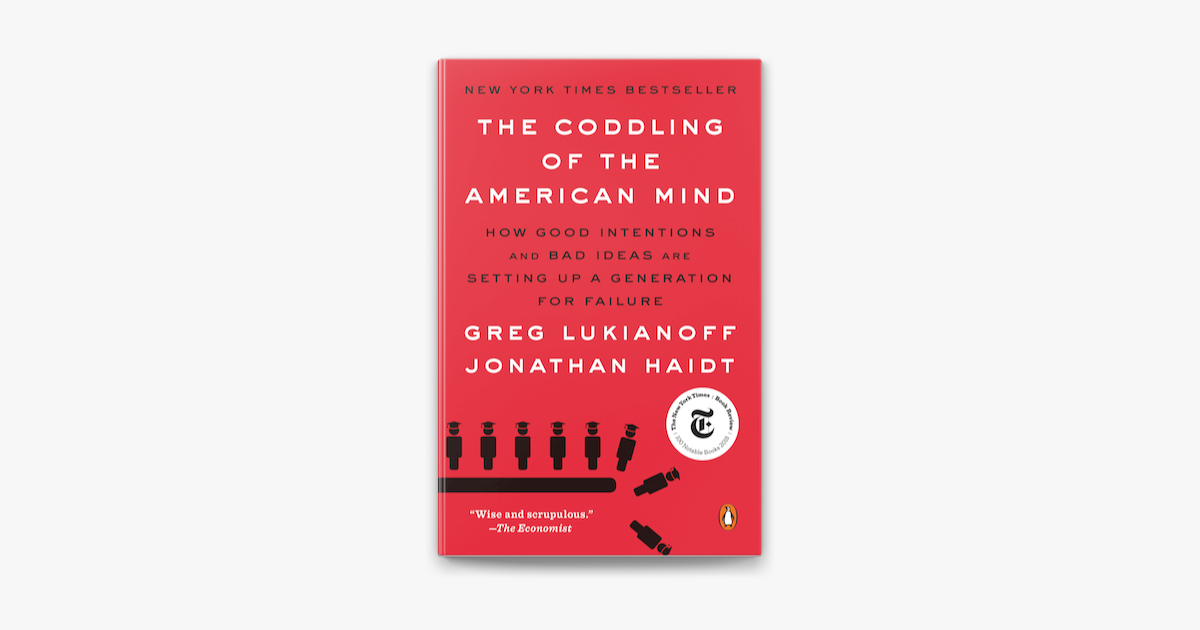
The Coddling of the American Mind: How Good Intentions and Bad Ideas Are Setting Up a Generation for Failure, authored by social psychologist Jonathan Haidt and free-speech activist Greg Lukianoff, diagnoses a profound cultural shift on American college campuses. The authors argue that a well-intentioned but destructive evolution in child-rearing and educational practices has inadvertently harmed young people's resilience, mental health, and capacity for critical thinking.
The core of the book revolves around three psychological misconceptions that have become deeply embedded in modern parenting and education, which the authors call the Three Great Untruths. The first is the Untruth of Fragility, the belief that what does not kill you makes you weaker. Haidt and Lukianoff argue that human minds are antifragile, much like the immune system or physical muscles, meaning they actually require stress, conflict, and exposure to minor hardships to develop resilience. Protecting children from every discomfort stunts their psychological growth.
The second misconception is the Untruth of Emotional Reasoning, the idea that one should always trust their feelings. The authors critique the modern tendency to conflate feeling unsafe with being in physical danger. When institutions prioritize subjective emotional responses over objective reality, they teach young people to engage in cognitive distortions like catastrophizing and mind-reading. The third misconception is the Untruth of Us Versus Them, which views life as a battle between good people and evil people. This mindset fuels tribalism through common-enemy identity politics, which views the world strictly as a rigid hierarchy of intersectional power struggles, rather than focusing on shared human values.
To explain why these untruths took root so rapidly in the 2010s, the authors identify six interacting cultural and social trends. First, the intense polarization of American politics transformed colleges into ideological monocultures where dissenting views are rarely voiced or tolerated. Second, a documented, sharp increase in anxiety and depression among Gen Z coincided directly with the proliferation of smartphones and social media around 2012, exposing adolescents to intense social comparison. Third, a decline in unsupervised play, driven by overprotective parenting and exaggerated media narratives about crime, deprived children of the freedom to navigate minor risks and resolve peer conflicts independently. Fourth, the bureaucratization of campus life led to an explosion in administrative positions focused on risk management, treating students as consumers who must be protected from intellectual discomfort through safe spaces and trigger warnings. Fifth, an obsession with an equal-outcomes-only framework of social justice began punishing nuance and chilling free inquiry. Sixth, the rise of safetyism expanded the definition of safety from physical protection to include guarding students against ideas, words, and speakers that cause psychological discomfort.
When these factors combine, they create a culture of safetyism. The authors document numerous case studies from universities where speakers were uninvited or violently protested. The tragic irony of safetyism is that it utilizes the exact opposite principles of Cognitive Behavioral Therapy, or CBT. While CBT teaches individuals to face their fears and reframe negative thoughts rationally, modern campus culture encourages students to avoid discomfort and assume the worst possible intentions behind every interaction. This results in an atmosphere of mutual suspicion, where both students and professors practice self-censorship out of fear of social or professional ruin.
Haidt and Lukianoff conclude by offering actionable solutions for parents, K-12 educators, and universities to reverse these trends.
For parents, they recommend allowing children more unstructured, unsupervised free play, teaching them to question their feelings before reacting, and consciously exposing them to differing perspectives. For universities, they advise committing explicitly to institutional neutrality on political matters, endorsing free-speech frameworks like the Chicago Principles, and cultivating a culture of viewpoint diversity where students are taught how to debate constructively rather than retreat into ideological echo chambers.